
Trauma Treatment in Thailand: Why Pacing and Sequence Define Successful Recover
Ask about trauma treatment and you will mostly be sold a method. EMDR. Somatic experience. Brainspotting. Each has evidence behind it, and each is presented by someone as the thing that finally works. What determines outcomes in practice is rarely which method appears in the brochure; it is whether the treatment is delivered in the right order, at a pace the person’s nervous system can absorb.
This guide explains the phase-based approach that underpins credible trauma treatment in Thailand: what happens in each phase, how trauma work is integrated with substance dependence rather than postponed behind it, and how to judge whether a programme is pacing you properly or rushing you.
Why Pacing and Order Matter More Than Single Modalities
The evidence base for trauma therapy is genuinely encouraging, and several approaches produce good outcomes. What the comparative research consistently fails to show is one modality that reliably outperforms the others for everyone. Method matters far less than fit, timing and delivery. This is why the more useful question to ask a treatment centre is not “do you offer EMDR?” but “how do you decide when someone is ready for processing work, and what do you do if they are not?” A programme with one answer for every guest is describing a product. A programme that can explain its sequencing is describing clinical practice. The risk of getting the order wrong is not theoretical. Processing traumatic material before a person has the capacity to regulate what it brings up can increase symptoms, worsen sleep, deepen dissociation, and for people with a substance history trigger a return to use. The therapy was not wrong; the timing was.
Single-event trauma and prolonged relational trauma
Trauma treatment is not reserved for people who meet full diagnostic criteria for PTSD. Impairment, not a diagnostic label, is what determines whether treatment is warranted and many people who benefit most from trauma-focused care would not tick every box on a checklist.
The clinically important distinction is between two broad patterns:
- Single-event trauma: an accident, an assault, a medical emergency, a disaster. The person often had a functioning baseline before the event and a clear sense of what changed. Treatment can frequently move to processing relatively early.
- Prolonged or relational trauma childhood neglect or abuse, coercive relationships, long-term caregiving under threat, years of high-exposure work. Here the effects are woven into identity, attachment and self-regulation rather than attached to one memory. ICD-11 recognises this pattern as complex PTSD, adding difficulties with emotion regulation, self-concept and relationships to the core PTSD features.
The second pattern requires a longer stabilisation phase, and attempting to shortcut it is one of the most common reasons trauma treatment destabilises people. Someone whose difficulty is regulating emotion and trusting others is not helped by being moved quickly into detailed recall of what happened to them.
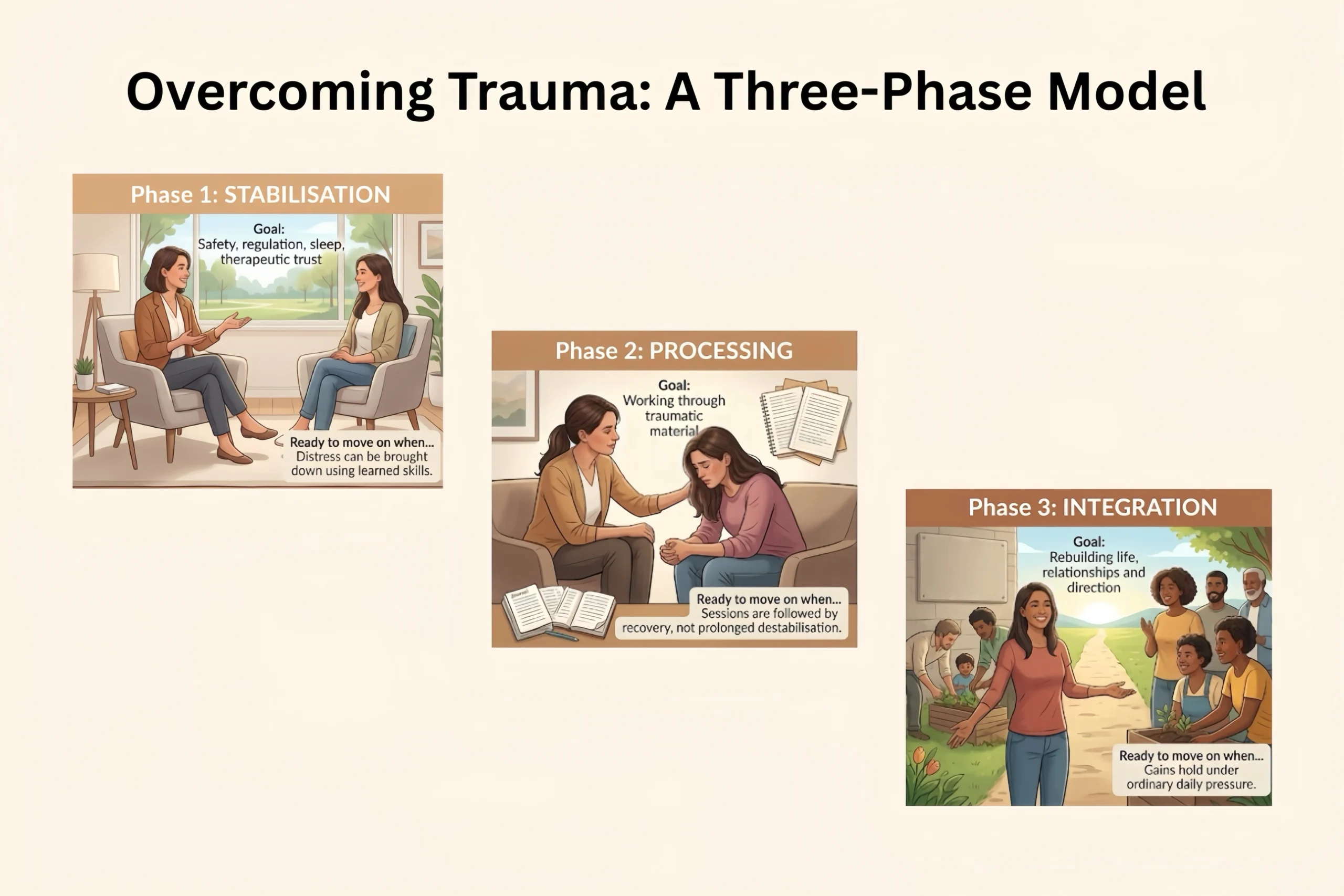
The Three-Phase Model: Stabilisation, Processing, and Integration
Phase-based treatment has been the backbone of complex trauma care since Judith Herman’s formulation in the early 1990s, and it remains the framework most trauma-informed programmes are built around. The phases are sequential in logic but not rigid in practice — people move back a phase when circumstances demand it, and that is a sign the model is working, not failing.
Phase 1: Nervous system safety, sleep and rapport
The first phase is not preparation for treatment, it is treatment. Its work is establishing external safety, restoring sleep, building emotional regulation skills, and forming a therapeutic relationship solid enough to hold what comes next.
Sleep deserves particular emphasis. A person who has not slept properly for months has reduced emotional regulation, impaired memory consolidation and a lower threshold for overwhelming the exact capacities trauma processing depends on. Restoring a sleep pattern is frequently the single highest-value intervention of the first fortnight.
Also built here is a practical, tested toolkit: grounding techniques, breath-based regulation, distress tolerance skills, and a shared vocabulary between guest and therapist for describing internal states. The measure of readiness for phase two is simple and behavioural when distress rises, can the person bring it down using something they have learned?
Phase 2: Processing, tailored to the person
Processing is where traumatic material is worked through directly so that it becomes memory rather than an ongoing present-tense experience. The method is chosen for the person and the trauma type, drawing on our range of psychotherapy approaches rather than applying one protocol to everyone.
Two principles govern this phase. The first is the window of tolerance: work is titrated so the person stays in a state where they are activated enough to process but not so overwhelmed that they shut down or dissociate. The second is recovery time. A processing session is followed by deliberate downtime, body-based regulation and, where needed, contact with clinical staff which is precisely the support that weekly outpatient therapy cannot provide, and the strongest argument for residential care during this phase.
Phase 3: Integration and life planning
The final phase addresses what is left once symptoms loosen: rebuilding relationships, re-establishing work and routine, and forming a sense of direction that is not organised around what happened. For people whose adult life has been shaped by trauma, this phase is often the least anticipated and the most demanding question “what do I actually want?” can be harder than any processing session.
Practical planning belongs here: what the first month home looks like, what returning to work involves, which relationships need renegotiating, and what ongoing therapeutic support is in place. Treatment that ends when symptoms improve leaves this work undone, and it is frequently where gains are lost.
Signs a programme is pacing you too fast
Ask about these directly during admissions, and pay attention if they appear once treatment starts:
- Trauma processing scheduled in the first days, before any stabilisation work
- Back-to-back intensive sessions with no recovery time between them
- Symptoms, sleep or dissociation worsening across weeks with no change to the plan
- No clinical staff available between sessions when material surfaces
- A fixed protocol applied identically to every guest regardless of presentation
*Good trauma treatment can feel demanding, but it should not leave you consistently less able to function week after week. If it does, the pacing needs to change, say so, and expect the plan to be revised.
Integrating Trauma Care with Substance Dependence
Co-occurring trauma and addiction
Trauma and substance dependence travel together often enough that treating either in isolation is usually a false economy. For many people, substance use began as a workable way of managing intrusive memories, hyperarousal or sleeplessness which is why removing it without addressing what it was managing tends to be unstable. Addressing underlying emotional wounds is essential for sustainable recovery. Learn why trauma-informed care is essential in mental health and addiction recovery.
The old clinical convention was sequential: get clean first, deal with trauma later, sometimes much later. Current evidence does not support that as a general rule. Integrated approaches that treat post-traumatic stress and substance use concurrently, the best studied being COPE, which combines prolonged exposure with substance-focused cognitive behavioural work are feasible, well tolerated and effective at reducing both. Notably, trauma-focused work in these trials did not worsen substance use outcomes, and treating the trauma often reduced substance use severity.
What remains non-negotiable is medical safety at the start. Where physical dependence is present, stabilisation through supervised detox in Thailand comes first both because withdrawal from alcohol or benzodiazepines can be medically dangerous, and because a person in acute withdrawal cannot do meaningful therapeutic work. Integrated does not mean simultaneous from day one; it means both conditions are held by one team within one plan.
Building sustainable routines
Recovery from either condition rests on the same unglamorous foundation: consistent sleep, regular meals, daily movement, structured days and social contact. These are not wellness extras. They are what stabilises the physiological systems that both trauma and substance dependence disrupt.
Integrated residential rehab programs are effective in addiction recovery in Thailand partly because they make those routines the default for long enough that they stop requiring willpower. Several weeks of a reliably structured day does something that instruction alone cannot it gives the nervous system evidence that predictability is available, which is the ground everything else is built on.
Multidisciplinary Healing: Body Work and Emerging Technologies

Nervous system regulation through body-based work
Trauma is stored physiologically as much as narratively chronic muscular guarding, shallow breathing, disrupted sleep architecture, and a startle response that fires before thought. Insight alone rarely reaches those systems.
Body-based work runs alongside psychotherapy throughout all three phases. Our holistic wellness therapy uses breathwork, bodywork and restorative practice to downregulate a chronically activated stress response, while structured, precise movement in our Pilates studio rebuilds body awareness and the felt sense of physical safety that trauma erodes. In phase one this work builds regulation capacity; in phase two it provides the recovery that makes processing sustainable.
Choosing the Appropriate Level of Mental Health Care
Residential care is not automatically the right level for everyone. Outpatient therapy, intensive outpatient programmes and residential treatment each suit different circumstances, and a responsible assessment may conclude that a residential admission is not what you need.
When you are comparing options for mental health treatment in Thailand, verify:
- Licensing: the facility’s registration with health authorities, and the credentials of the clinical team
- Medical cover: psychiatric input, overnight nursing, and what happens if someone becomes acutely unwell
- Assessment: a clinical pre-admission evaluation, not a booking form
- Sequencing: a clear, explainable answer on how phases and readiness are decided
- Continuum: whether detox, residential treatment and aftercare are provided by one coordinated team
Structured remote follow-up
Phase three does not finish at discharge. A structured aftercare program maintains contact with the clinical team, provides online group support, and works from a written continuing-care plan covering ongoing therapy, routine, early warning signs and who to contact when things become difficult. For trauma and addiction alike, the months after treatment are when the plan is genuinely tested.
Frequently Asked Questions

Take the First Step Toward Healing with Our Team
If you are considering trauma treatment in Thailand, for yourself or someone close to you, a clinical conversation will tell you more than any amount of comparing websites. Our team can talk through what has happened, what has been tried, and what level of care is appropriate. You can reach us at The Beekeeper House Chiang Mai.